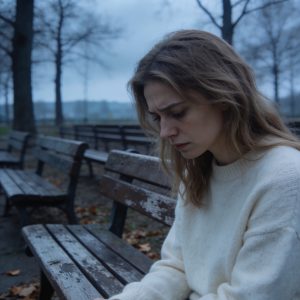
My neighbor kept insisting she’d seen my daughter at home during school hours—so I pretended to leave for work and hid under her bed. What I overheard next made my blood run cold.
My name is Natalie Brooks, and until that week, I would have told anyone I knew my fourteen-year-old daughter better than anyone else in the world.
Since the divorce, it had been just Harper and me in our quiet New Jersey suburb. She was the kind of girl teachers praised without hesitation—disciplined, soft-spoken, mature. Neighbors called her “a sweetheart.” I wore that reputation like armor. Proof that despite everything, I was doing okay as a mother.
I didn’t question her.
Not really.
Until Wednesday morning.
I was locking my front door when Mrs. Donnelly from next door called out to me.
“Natalie,” she said carefully, glancing around as if the hedges might be listening, “is Harper staying home from school lately?”
The word lately hit harder than it should have.
“No,” I answered quickly. “She hasn’t missed a day.”
Mrs. Donnelly hesitated. “I may be mistaken… but I’ve seen her come back mid-morning. A couple of times. And once, I’m almost certain she wasn’t alone.”
My pulse began pounding in my ears.
“I’m sure it’s a misunderstanding,” I said, forcing a smile that felt brittle.
But the seed had been planted.
At work, I couldn’t focus. Harper had been different—more withdrawn, locking her bedroom door, staying up later than usual. I had blamed hormones. Teenage privacy. Growing pains.
Now every change felt deliberate.
That evening, I mentioned it casually over dinner.
“Mrs. Donnelly thinks she saw you home during school hours,” I said lightly.
Harper barely reacted. “She must’ve seen someone else,” she replied calmly. “I’m at school, Mom.”
Her voice was steady.
But she looked down at her plate a second too long.
I didn’t sleep much that night.
The next morning, I followed our routine. Coffee. Backpacks. A quick kiss on her cheek.
“Have a good day,” I told her.
“You too,” she said softly.
I waited fifteen minutes after she left.
Then I drove around the block, parked behind the line of tall maples along our fence, and slipped back inside through the side door.
The house was silent.
Harper’s room was immaculate—almost staged. Bed perfectly made. Curtains drawn just enough to let in a thin slice of light.
If she thought I’d gone to work… she wouldn’t expect me here.
My heart hammered as I lowered myself to the floor and slid under her bed. The space was tight, dusty, suffocating. I silenced my phone and fixed my eyes on the narrow strip of light beneath the door.
9:02 a.m.
Nothing.
9:17 a.m.
Doubt crept in. Maybe I was paranoid. Maybe I was about to betray my daughter’s trust over a neighbor’s mistake.
Then—
The front door clicked open.
Footsteps.
Slow. Careful.
Not the rushed steps of someone grabbing forgotten homework.
They came down the hallway.
Stopped outside her room.
The door opened.
I held my breath as Harper’s voice floated through the room—
Low.
Urgent.
And she wasn’t speaking to herself.
Harper stepped into her room and shut the door gently behind her.
I could see only her feet from where I lay under the bed—white sneakers pacing once, twice. Then another set of footsteps entered.
Heavier.
Older.
My heart slammed so hard I was sure they could hear it.
“Did anyone see you?” Harper whispered.
“No,” a male voice answered. Young. Nervous. Not a grown man—but not a little boy either.
Relief flickered for half a second. Then dread replaced it.
“I can’t keep missing practice,” he said. “Coach is already suspicious.”
Practice.
My mind scrambled to place the voice.
Then it clicked.
Tyler Jennings. Seventeen. High school senior. Lived three streets over. I’d seen him mowing lawns last summer.
“What about your mom?” he asked.
“She thinks I’m at school,” Harper replied. “Mrs. Donnelly almost ruined everything.”
Everything.
I felt sick.
There was the rustle of backpacks dropping to the floor. The soft thud of someone sitting on the edge of the bed—so close I could see the mattress dip inches from my face.
“You can’t keep skipping,” Tyler said. “If they call your mom—”
“I know,” Harper snapped quietly. “I just… I needed a break.”
Her voice cracked.
The anger drained out of me, replaced by something colder. Something steadier.
A break from what?
“I can’t breathe there anymore,” she whispered. “Everyone expects me to be perfect. Dad. Mom. Teachers. I’m so tired.”
Silence.
Then softer, Tyler said, “You don’t have to be perfect.”
The words hung in the air.
I realized then what I was actually hearing.
Not manipulation. Not something sinister.
Two teenagers making reckless choices because they felt cornered.
But reckless didn’t mean harmless.
I slid out from beneath the bed.
Harper gasped. Tyler shot to his feet so fast he knocked over her desk chair.
“Mom?!” Harper’s face drained of color.
Tyler looked like he might bolt for the window.
“Stay,” I said firmly.
My voice surprised even me—calm. Controlled.
“I’m not here to scream,” I continued. “But we are going to talk.”
Harper’s eyes filled instantly. “You weren’t supposed to—”
“I know,” I said gently. “And you weren’t supposed to be here either.”
Tyler stammered apologies, explaining they hadn’t done anything, that they just talked, that Harper had been overwhelmed and didn’t know how to tell me she was struggling.
And as I looked at my daughter—really looked at her—I saw it.
The exhaustion. The pressure. The fear of disappointing me.
“I would rather have a messy truth than a perfect lie,” I told her quietly.
Tyler left ten minutes later, pale and shaken, promising never to step foot in our house again without permission.
Harper and I sat on her bed for a long time after that.
There would be consequences. School would be informed. Boundaries would be set.
But there would also be counseling. Conversations. Space for imperfection.
Mrs. Donnelly had been right.
My daughter had been coming home during school hours.
What she hadn’t seen—
Was how close I’d come to losing her trust completely by assuming the worst.
And how close Harper had come to breaking under the weight of trying to be everything I thought she was.